


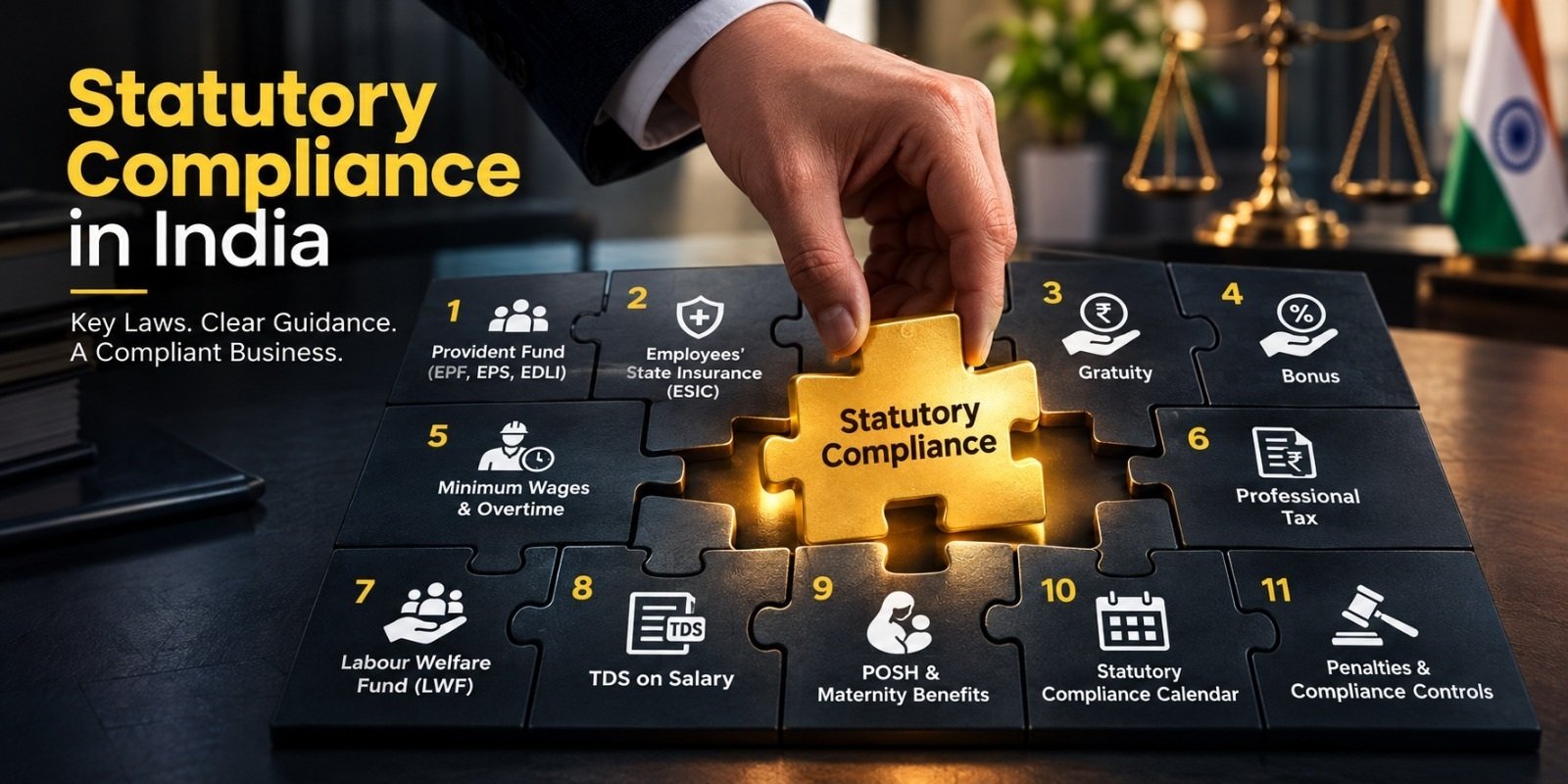
Statutory Compliance in India: PF, ESIC, Professional Tax, LWF, Gratuity, Bonus and TDS, Explained for 2026
Statutory compliance is non-negotiable and non-delegable. Directors and officers can be held personally liable, and penalties compound quickly. This blog explains each major statute, what it requires, and what changed in 2026.
1. Provident Fund (EPF, EPS, EDLI)
What it is: retirement savings and pension coverage for employees, managed by the EPFO.
What changed: on 17 September 2026, the wage ceiling rose from ₹15,000 to ₹25,000. Notification No. 5109(E) dated 17 September 2026 expands mandatory coverage under EPF, EPS and EDLI, and the government expects over 51 lakh more employees to come within coverage. The ceiling had stayed at ₹15,000 since September 2014.
Employer actions:
- Identify employees now in the ₹15,000–₹25,000 band; complete UAN, KYC and e-nomination
- Update payroll masters and PF policy
- For September 2026, compute in two parts (1–16 and 17–30 September) and file a single ECR
- Pay by the 15th of every month; September's due date is 15 October 2026
- Consider the Employees' Enrolment Campaign 2026 for previously unenrolled employees who joined between April 2009 and March 2026
- Check PM-VBRY incentives that may offset the extra cost
Risks: interest and damages for delays, and inspection for non-enrolment. Legacy defaults may be eligible for settlement under EPFO's VISHWAS 2026 scheme; [verify the current window with an advisor].
2. Employees' State Insurance (ESIC)
- Covers employees up to a wage ceiling of ₹21,000 per month, which the September notification did not change [verify]
- Contributions: employer 3.25% and employee 0.75% of wages
- Register new joiners as Insured Persons from day one
- Contributions by the 15th of the following month; half-yearly returns by 11 May and 11 November
- Benefits include medical care, sickness, maternity and disability benefits, so keeping data accurate matters to employees directly
3. Gratuity
- Payable on retirement, resignation, death or disablement
- Formula: (15 × last drawn wage × years of service) ÷ 26
- Standard employees: five years of continuous service (with the usual exceptions for death or disablement)
- New: fixed-term employees are eligible for pro-rata gratuity after one year
- Because "wages" now carries the 50% rule, gratuity liability generally rises; update your actuarial provision
4. Bonus
- Annual bonus is paid by eligible employees at a statutory minimum of 8.33% and a maximum of 20% of wages, subject to the wage and eligibility limits prescribed [verify current ceilings under the Code on Wages]
- Maintain bonus registers and pay within the prescribed time after the accounting year ends
5. Minimum wages, timely payment and overtime
- Pay at least the state minimum wage for the category of work
- Pay wages by the statutory date; monthly wages are generally due by the 7th [verify under your state rules]
- Overtime is paid at twice the ordinary rate
- On exit, settle wages within two working days
- Equal pay for equal work, regardless of gender, applies
6. Professional Tax (state-specific)
- Levied by states on salaried employees and professionals; employers deduct and deposit
- Karnataka notified the Karnataka Tax on Profession, Trades, Callings and Employments (Amendment) Act, 2026 to simplify compliance [verify slabs, thresholds and due dates]
- Register as an employer, deduct monthly, and file returns on time
7. Labour Welfare Fund (state-specific)
- In Karnataka, the amendment effective 7 January 2026 reduced the threshold from more than 50 persons to 10 or more persons
- Employee and employer contributions can be made via net banking, NEFT, RTGS, UPI or demand draft
- The calendar-year cycle ends with an annual statement due by 15 January of the next year
- The change applies to calendar year 2026, not 2025
8. TDS on salary (Income-tax)
- Employers deduct tax on salary based on the employee's chosen regime and declarations
- Tax Year 2026-27 runs under the Income-tax Act, 2025
- Deposit TDS by the 7th of the following month; file quarterly returns; issue Form 16 by 15 June [verify under the new Act's numbering]
- Collect investment declarations early and proofs before the final quarter
9. POSH, Maternity Benefit and other people-related statutes
- POSH Act: Internal Committee for 10+ employees, annual report, awareness programmes
- Maternity Benefit Act: 26 weeks of paid leave for the first two children, creche for 50+ employees
- Shops and Establishments Act: state-specific working hours, holidays and registers
10. Consolidated statutory calendar
| Date | Compliance |
|---|---|
| 7th (monthly) | TDS deposit; wage payment deadline for monthly wages [verify] |
| 15th (monthly) | PF ECR and payment; ESIC contribution |
| State date (monthly) | Professional Tax |
| 11 May / 11 Nov | ESIC half-yearly returns |
| Quarterly | TDS returns (24Q) |
| 15 Jan | Karnataka LWF annual statement |
| 15 June | Form 16 |
| Annually | Bonus, gratuity provision, annual returns, POSH report |
11. Penalties and how to avoid them
- Interest and damages on delayed PF and ESIC payments
- Late fees on TDS returns and penalty for non-deduction or non-deposit
- Prosecution provisions under the Labour Codes for serious or repeated violations
- Director and officer liability
To avoid them: keep a calendar with named owners, reconcile monthly, retain proof of every filing, run a half-yearly compliance audit, and subscribe to updates from the EPFO, ESIC and your state labour department.
Conclusion
Statutory compliance rewards the organised and punishes the casual. With the Labour Codes in force, a higher PF ceiling and expanding state requirements, 2026 is the right moment to rebuild your compliance system, so that the next change takes a day to implement and not a month.